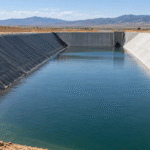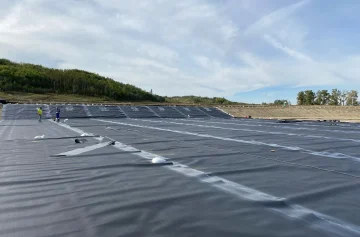

A manure lagoon liner must be specified as part of the waste-storage system: sheet material and thickness, foundation, protection, seams, anchorage, groundwater control and inspection all matter. HDPE is a common candidate, but the material name alone does not establish compliance or control leakage.
For US projects, confirm the applicable state requirements, permit and local NRCS documents before ordering. This guide separates published criteria from illustrative quantity calculations and supplier quotation details.
Start with the governing specification and exact thickness
NRCS national Code 521, August 2023R, lists a 60 mil minimum for HDPE and LLDPE in wastewater service, versus 30 mil for clear water. It also addresses groundwater, cushioning, protection and leak detection. Use the applicable local standard and approved drawings to establish the actual requirements; an older Vermont specification is not a nationwide rule.
Do not silently substitute a rounded metric trade grade for an exact inch-based minimum. 60 mil is 1.524 mm, not 1.500 mm; 30 mil is 0.762 mm, not 0.750 mm. State whether the order uses a nominal metric grade or an inch-based requirement, and define the thickness acceptance method.
| Thickness basis | Exact metric thickness | Calculated mass at 940 kg/m³ | Mass over one acre of flat sheet |
|---|---|---|---|
| 30 mil | 0.762 mm | 0.7163 kg/m² | About 2.90 tonnes |
| 60 mil | 1.524 mm | 1.4326 kg/m² | About 5.80 tonnes |
| 1.50 mm metric grade | 1.500 mm | 1.4100 kg/m² | About 5.71 tonnes |
| 2.00 mm metric grade | 2.000 mm | 1.8800 kg/m² | About 7.61 tonnes |
Mass = thickness × density × area, using one acre = 4,046.856 m². These are geometric estimates for sheet at the assumed density, excluding seams, slopes, anchorage and packaging. Actual shipment weights come from the roll list.
Solids content, agitation equipment and a planned biogas cover can introduce additional design demands. They do not create a universal three-question test that automatically determines thickness. A thicker liner also does not make direct machinery traffic acceptable.
HDPE, LLDPE and textured surfaces: compare the right properties
Use GRI-GM13 Revision 19 for the specified HDPE manufacturing quality requirements and GRI-GM17 Revision 17 for LLDPE, both dated June 11, 2025. These specifications do not replace a project design or certify the completed lagoon.
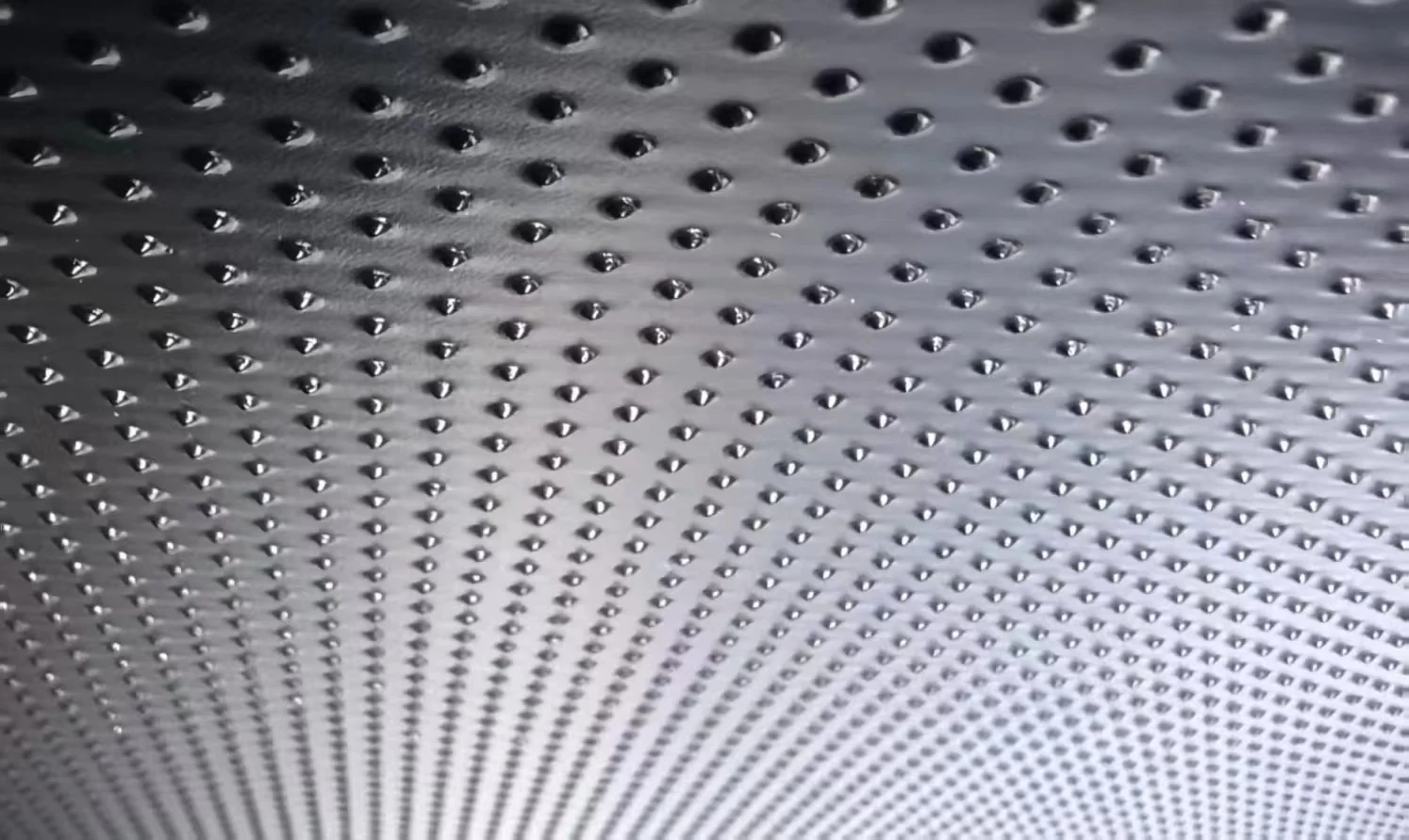
Selected GM13 metric-table values illustrate the difference between surface types:
| Metric grade | Smooth yield strength | Smooth break strength | Textured break strength | Smooth / textured index puncture |
|---|---|---|---|---|
| 1.50 mm | 22 kN/m | 40 kN/m | 16 kN/m | 480 / 400 N |
| 2.00 mm | 29 kN/m | 53 kN/m | 21 kN/m | 640 / 534 N |
These are specification values under the named test methods, not measured Jinseed batch results or allowable in-service loads. GM13’s English and metric tables use soft conversions; do not combine a metric property row with an exact thickness claim without defining the procurement basis. Obtain the full specification, sampling frequencies and corresponding batch records.
LLDPE can be considered where flexibility is relevant, but a laboratory break elongation is not the strain that an installed liner can safely sustain. Settlement assessment must account for local deformation, seams, penetrations and restraint. Do not apply HDPE resin-density requirements to LLDPE.
Texture does not provide a universal 30° friction angle, and a smooth liner is not automatically safe below 21.8°. ASTM D5321/D5321M-26 evaluates interface shear under selected conditions. Test the actual contact materials and relevant stress, moisture and displacement conditions, then assess stability. For GCL interfaces, the method selection differs.
A design may use different materials in different zones, but an HDPE-to-LLDPE transition cannot be accepted merely because both are polyethylene. Specify and qualify the proposed joint using the actual sheets and a suitable test and acceptance programme. See the HDPE and LLDPE comparison for the distinctions.
Storage capacity and local rules are separate from liner selection
NRCS national Code 313, August 2023, bases storage duration on the interval between emptying events and environmentally suitable use of the waste. It does not impose a universal 180-day period. Its capacity framework includes operational storage, emergency precipitation/runoff and applicable freeboard. The national freeboard minima for precipitation-exposed storage are 6 inches for vertical-walled facilities and 12 inches for other facilities, subject to the document’s conditions and local requirements.
Moving an assumed operating period from 180 to 270 days adds 50% to the accumulated-waste component only if generation is constant. It does not necessarily add 50% to the whole facility capacity: rainfall, runoff, residual solids and freeboard need their own calculations.
Code 313 also gives different minimum lateral pressure gradients for certain fabricated storage structures: 65 lb/ft² per foot of depth for unprotected waste, 60 for waste protected from precipitation and unlikely to become saturated, and 72 for specified sand-laden manure. These are structural loading criteria, not evidence that adding a floating cover lowers liquid pressure.
For a liquid of unchanged density, hydrostatic pressure remains p = ρgh. At an illustrative density of 1,000 kg/m³ and 4 m depth, p is approximately 39.2 kPa. A cover does not change that calculation merely by being present.
Confirm setbacks, bedrock and groundwater separation, storm design, access controls and permits with the responsible authority. Do not transplant a table of distances from another state. EPA’s animal feeding operation guidance explains the AFO/CAFO and NPDES framework; animal counts alone are not a complete permit determination. Municipal landfill liner criteria should not be presented as manure-lagoon rules.
Control uplift, leakage and mechanical damage
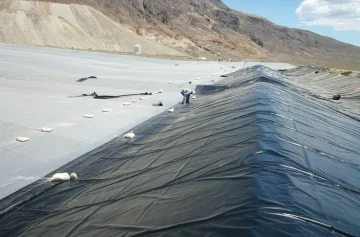
Investigate seasonal groundwater, seepage paths, buried organics and the lagoon’s empty or partially emptied condition. Gas or water below a sheet can lift it; the corrective system must address the actual cause. One diagonal drain pipe, a fixed vent count or a generic perimeter trench is not a complete hydraulic design.
Keep the functions separate:
- Groundwater drainage controls external water pressure where required.
- Gas relief below the liner addresses trapped gas beneath the containment sheet.
- Leak detection identifies or collects leakage from the containment system.
- Biogas collection above the liner belongs to the covered digestion system and must not be casually connected to underliner vents.
Under the cited Code 521, leak-detection requirements vary with the underlying soils and their properties. Specify the required arrangement for the site. Neither a universal 1 × 10⁻⁴ cm/s secondary-liner value nor a single 0.30 m-deep drain should be assumed for every US waste lagoon.
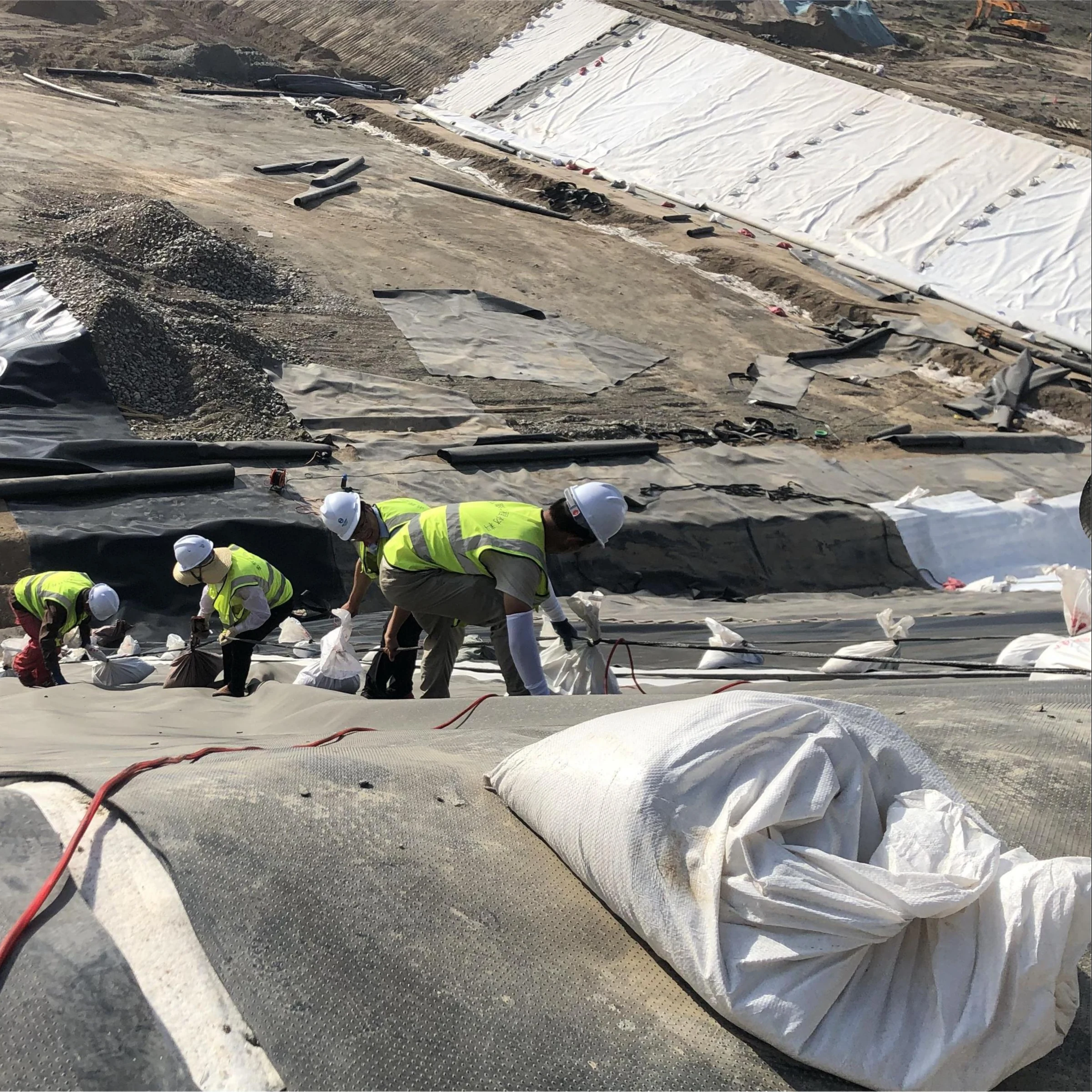
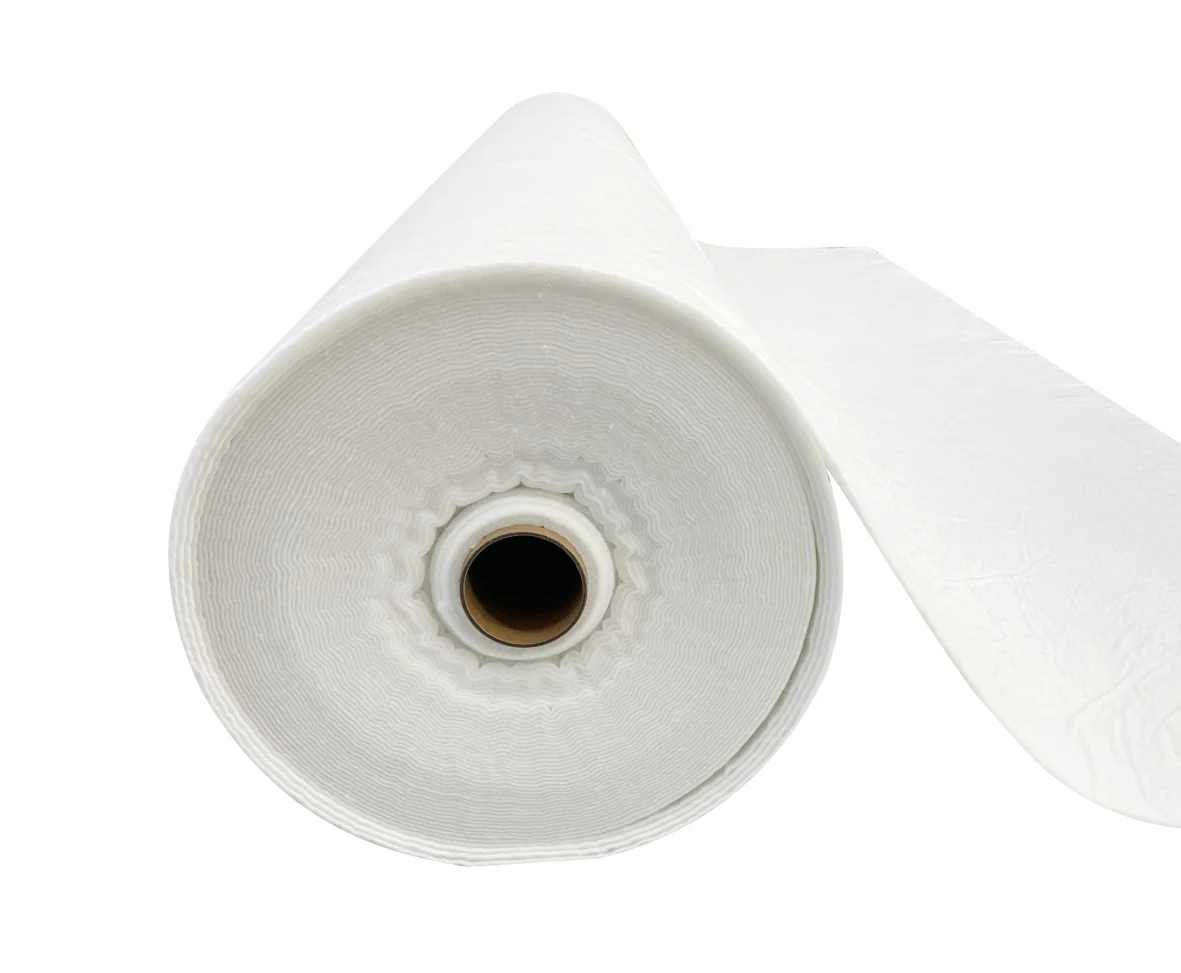
Use the specified subgrade and cushion system to address angular particles and installation loading. Fabric mass alone does not prove puncture protection. Agitation, inlets, pumps and solids removal need designed protective details and an operating method that avoids damaging the liner.
For a stated design requiring 12 inches of cover, use 304.8 mm in the volume calculation, not 300 mm when checking a minimum. Cover quantity is based on the protected area and required thickness—not purchased membrane area that also includes overlaps and offcuts. Plan placement in workable sections; dividing an entire project volume by 24 hours does not establish a safe construction programme.
Correctly calculate the floor and sloping sides
Consider a hypothetical square lagoon with a one-acre bottom, a 4 m vertical rise from the bottom to the liner’s top edge, and uniform 2.5H:1V side slopes. The rise here is a lining-geometry input, not permission to fill the lagoon to that elevation.
Bottom side b = √4,046.856 = 63.615 m. With slope ratio m and rise d, top side T = b + 2md, face length s = d√(1 + m²), and the four trapezoidal sides have area 2(b + T)s. Using bottom perimeter × face length omits the outward-widening corners.
| Quantity | 2.5H:1V example | 5H:1V alternative |
|---|---|---|
| Bottom side | 63.615 m | 63.615 m |
| Top side at 4 m rise | 83.615 m | 103.615 m |
| Sloping face length | 10.770 m | 20.396 m |
| Four side faces | 3,171.43 m² | 6,821.66 m² |
| Floor plus sides | 7,218.28 m² | 10,868.52 m² |
| Illustrative total with 15% added | 8,301.03 m² | 12,498.80 m² |
| Area-only count of 8 m × 140 m rolls | 8 rolls | 12 rolls |
The 15% addition is a budgeting assumption, not a standard loss factor or a verified panel layout. Eight rolls provide 8,960 m² gross, while seven provide only 7,840 m²—insufficient for the 8,301 m² example allowance. Actual panel cutting and anchorage can change the order further. The 5:1 alternative adds about 3,650 m² of developed lining area; it does not add only 2,449 m².
The anchor trench is near the upper perimeter, approximately 334.46 m in the 2.5:1 example, rather than the 254.46 m bottom perimeter. Determine membrane length through the actual trench cross-section, including crest setback, downstand, return and slack. Trench width and depth alone do not establish the sheet allowance.
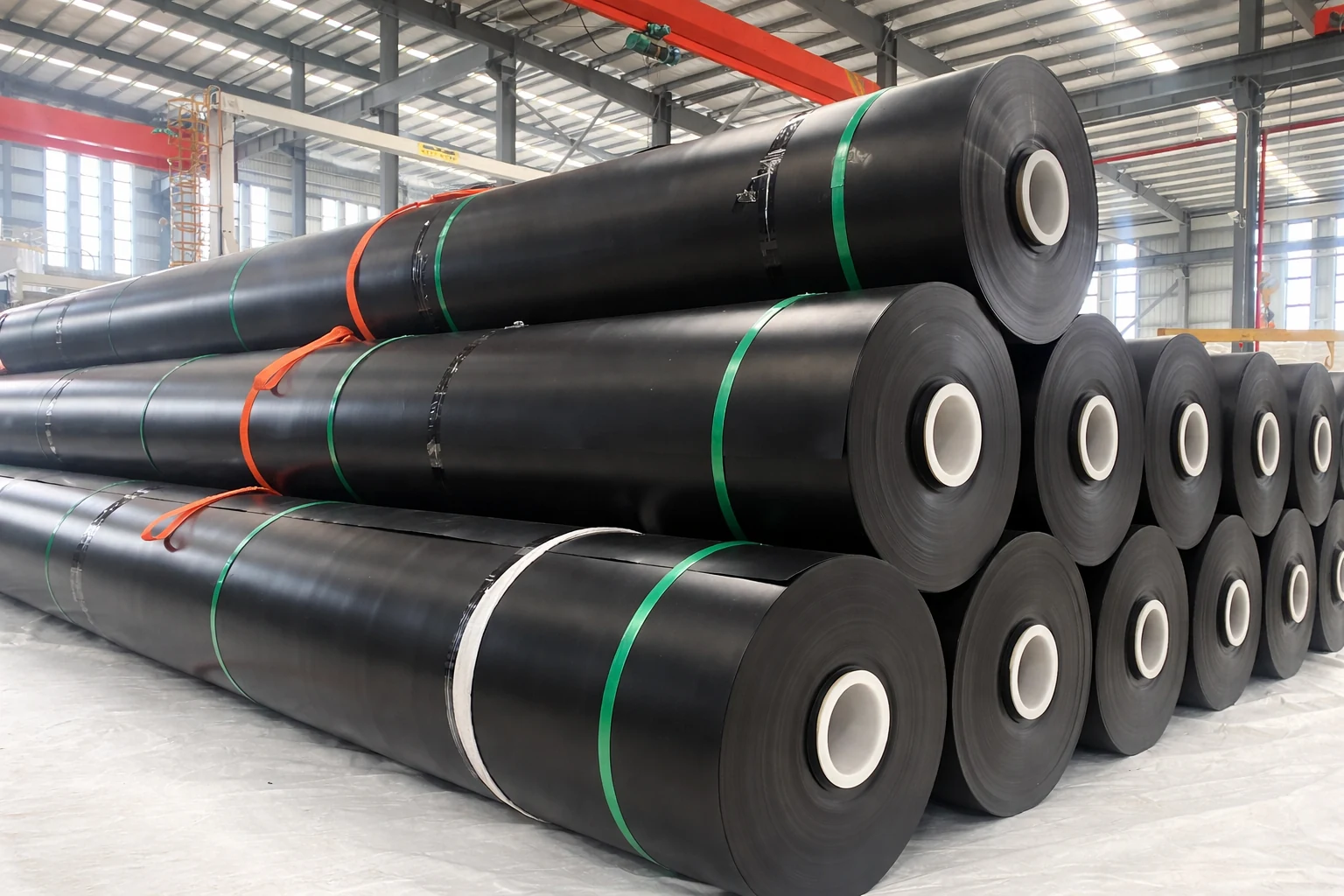
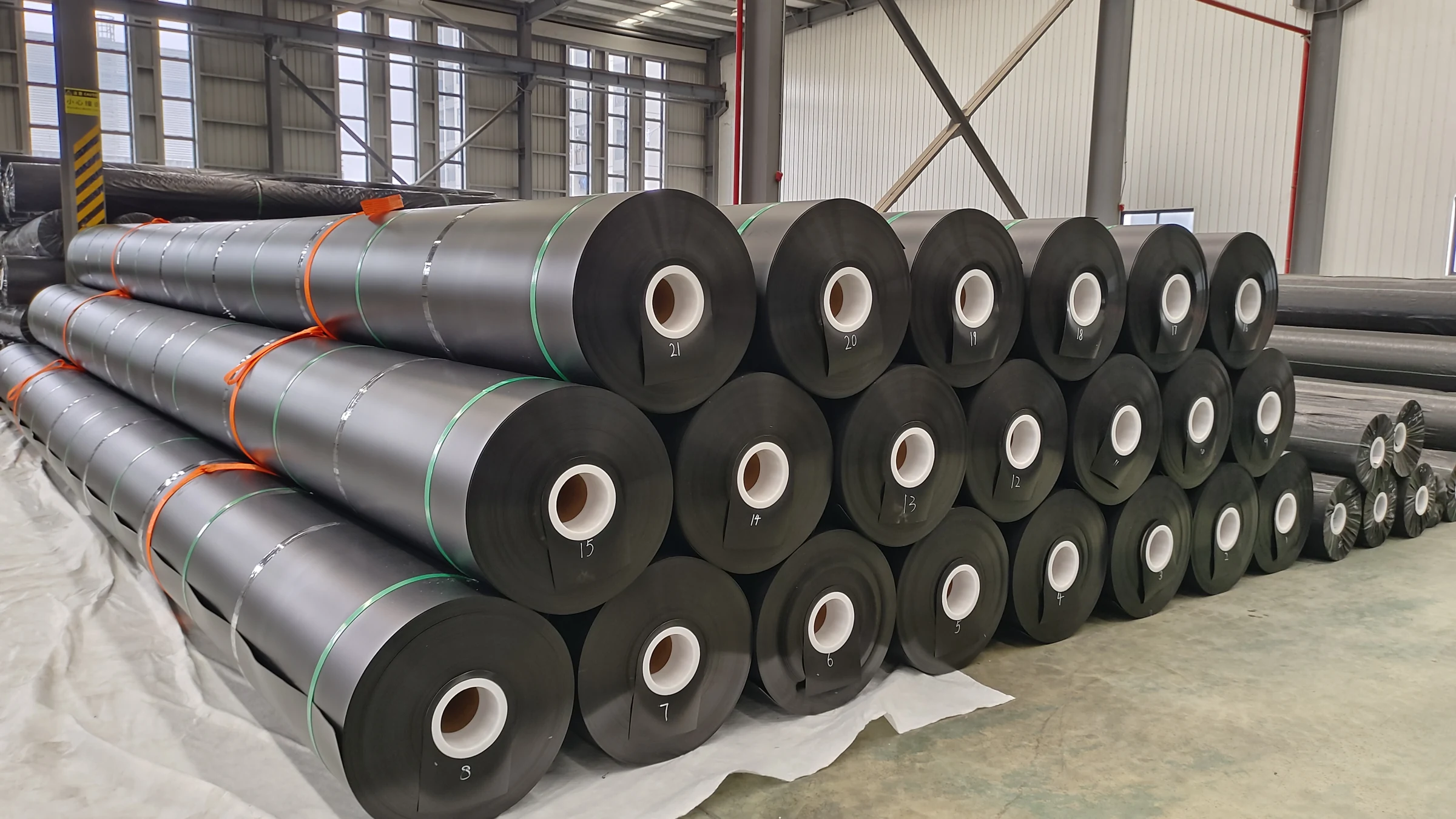
At 1.50 mm and the assumed 940 kg/m³ density, one 8 m × 140 m roll has an estimated sheet mass of 1,579.2 kg; eight total 12.63 tonnes before packaging. The same gross area at 2.00 mm is about 16.84 tonnes, an increase of 4.21 tonnes. These are metric-grade arithmetic examples, not confirmation of a 60 mil minimum or a container loading plan. Confirm commercial roll sizes, payload and handling in the written quotation.
Welding, testing and construction records

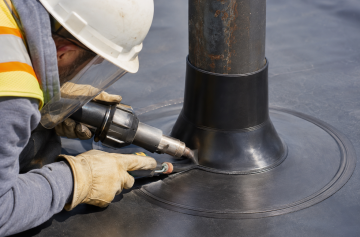
Specify qualified welding procedures, trial-seam conditions, seam identification and inspection records. Trial welds may be needed when equipment, operators, material or weather changes; “one per shift” is not a complete universal rule.
Distinguish non-destructive seam continuity checks from destructive peel/shear tests. ASTM D6392 addresses tests on nonreinforced thermo-fusion seams. The approved quality plan must state the applicable edition, sampling frequency, acceptance criteria and repair/retest procedure. Different seam geometries require suitable non-destructive methods; a vacuum box is not automatically workable on every detail.
Where an electrical leak-location survey is specified, select a method appropriate to the exposed or covered liner and the electrical conditions. A passed seam test does not demonstrate that the whole sheet remained undamaged during covering. Keep roll certificates, panel maps, seam logs, test results and repair locations together for handover.
Use field studies in their proper context
J. M. Ham’s 2002 Kansas investigation measured 20 animal-waste lagoons and evaluated their compacted soil liners. Reported seepage averaged 1.1 mm/day, with a 0.2–2.4 mm/day range. This is useful historical evidence about those systems, not an expected leakage rate through a newly welded HDPE sheet.
For scale only, applying 1.1 mm/day to 4,046.856 m² for 365 days yields about 1,625 m³. That conversion does not predict this hypothetical lagoon’s leakage. Separate water-balance measurements from rainfall, evaporation and operational inflow/outflow before diagnosing a problem.
Covered lagoons and service life
EPA’s AgSTAR dataset reports 400 operating manure-based digestion systems as of June 2024, including 174 covered lagoons—43.5%. These are dated industry statistics, not current Jinseed installations. Do not divide energy output for one reporting year by a different year’s system count and call it a representative project yield.
A floating cover requires its own gas collection, pressure control, anchorage, condensate and rainwater-management design. The bottom containment liner and the cover serve different duties. Use the gas-system specialist’s requirements and the selected membrane’s supporting data.
Service life depends on formulation, temperature, chemical exposure, stress and physical damage. GSI lifetime-prediction guidance explains why accelerated ageing estimates are conditional. Neither 50–100 years submerged nor 20–30 years exposed is a blanket warranty for an arbitrary product. Confirm the intended service period and any written warranty separately.
Set inspections around the operating plan, including storms, pump-out and agitation. Check accessible sheet, penetrations, anchorage, operating levels and monitoring points. Bulging can involve gas or groundwater; diagnose the cause rather than assuming that clearing a predetermined number of vents resolves it.
What to include in a manure-lagoon liner enquiry
- Location, lagoon use, waste composition, temperature and applicable project specification.
- Bottom dimensions, lining elevation, slopes, developed area and anchorage drawings.
- Material, surface type, exact thickness basis and protective layers.
- Groundwater, foundation conditions, leak-detection requirements and any biogas cover.
- Installation scope, acceptance testing, roll handling limits and required documents.
- Quantity, delivery destination and requested schedule.
Jinseed can prepare a material proposal and roll schedule for review against those requirements. Confirm minimum order, available dimensions, shipping and lead time in writing; repeated design changes do not have a predictable fixed effect on production days. Send your lagoon specification for a quotation, or review the HDPE geomembrane product page.
Numerical examples state their assumptions. Standards and published studies are not Jinseed batch tests, project case studies or a substitute for the approved site design.