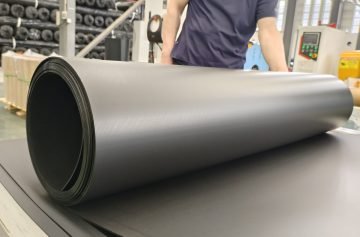
HDPE liner has no universal price per kg; the payable rate comes from a dated supplier quotation. For illustration only, USD 2.00/kg would equal USD 2.82/m2 for a 1.5 mm smooth sheet calculated at 1.41 kg/m2 using a density of 0.940 g/cm3 [1]. USD 2.00/kg is not a current market price or a Jinseed offer. To obtain an actual rate, specify thickness, surface, required standard, quantity and delivery terms.
Why is HDPE liner sometimes quoted per kg?
A per-kg quotation prices the mass of HDPE liner purchased, rather than the area covered. A tonne is 1,000 kg, so a quote per tonne divided by 1,000 gives the equivalent price per kg. At the same price per kg, thicker sheet costs more per m2 because it contains more material. Confirm whether billable weight means net sheet weight or includes cores and packaging.
How do you convert a per-kg quote to a per-m2 project cost?
Sheet cost per purchased m2 = quoted price per kg x kg per m2.
Installed cost per net lined m2 = total agreed material, delivery, installation, testing, and site-work costs / net lined area.
Smooth-sheet weight follows density in g/cm3 multiplied by thickness in mm. The table uses 0.940 g/cm3, the minimum average formulated sheet density in GRI-GM13 Revision 16 (March 17, 2021), which covers smooth and textured HDPE geomembrane from 0.75 to 3.0 mm [1]. Figures here support planning only, not measured delivery weights or a product guarantee. Thickness rows follow the GM13 scope; confirm the available gauge in the supplier quotation. M2-per-tonne values derive from the displayed rounded mass.
| Nominal thickness | Calculated mass at 0.940 g/cm3 | Approx. m2 per tonne | Sheet-cost calculation |
|---|---|---|---|
| 0.75 mm | 0.71 kg/m2 | about 1,408 m2 | Quoted price/kg x 0.71 |
| 1.0 mm | 0.94 kg/m2 | about 1,064 m2 | Quoted price/kg x 0.94 |
| 1.5 mm | 1.41 kg/m2 | about 709 m2 | Quoted price/kg x 1.41 |
| 2.0 mm | 1.88 kg/m2 | about 532 m2 | Quoted price/kg x 1.88 |
| 2.5 mm | 2.35 kg/m2 | about 426 m2 | Quoted price/kg x 2.35 |
| 3.0 mm | 2.82 kg/m2 | about 355 m2 | Quoted price/kg x 2.82 |
With a smooth 1.5 mm sheet at 1.41 kg/m2 and a hypothetical sheet-only quote of USD 2.00/kg, the calculation gives USD 2.82 per purchased m2. The numbers illustrate arithmetic only, with no link to market averages, installed rates, or a Jinseed quotation.
An 8.0 m by 100 m roll covers 800 m2, so the sheet weight comes to about 1,128 kg at 1.41 kg/m2, excluding core, packaging, and tolerance.
The calculation also works in reverse: a sheet-only price per m2 divided by kg per m2 gives the implied price per kg. Comparisons stay valid only on a common basis — sheet-only against sheet-only, not sheet-only against installed.
Textured sheet needs its delivered weight
Single- or double-sided textured liner needs a different check. Peak-to-peak thickness does not equal uniform sheet thickness; the specification measures core thickness and asperity height separately. Request the actual mass per unit area with roll weight and dimensions from the HDPE geomembrane manufacturer, and use the delivered mass in the conversion above [1].
What makes one per-kg quote higher than another?
Check polymer, formulation, surface and documented conformance before treating two per-kg offers as equivalent. GRI-GM13 Revision 16 specifies carbon black, oxidation resistance and mechanical-property minima; the label HDPE alone does not establish that a sheet meets them [1]. Compare the same currency, quotation date, order quantity and delivery basis, rather than attributing every price difference to material quality.
GM13 Revision 16 sets carbon black at 2.0 to 3.0% under ASTM D4218 and dispersion requirements under ASTM D5596. Initial oxidative induction time (OIT) must reach at least 100 minutes under ASTM D8117 or 400 minutes under ASTM D5885 [1]. After 90 days of oven aging at 85 C under ASTM D5721, the retained-OIT minima are 55% or 80%, respectively. After 1,600 hours under ASTM D7238, the retained high-pressure OIT minimum is 50%; the exposure cycle is 20 hours of UV at 75 C followed by four hours of condensation at 60 C [1]. These are laboratory acceptance criteria, not predictions of outdoor service life.
Mechanical requirements vary by surface. GM13 uses ASTM D6693 Type IV specimens, with five specimens in each of the machine and cross-machine directions. Yield elongation uses a 33 mm gauge length and break elongation a 50 mm gauge length [1]. The following minimum average values are from the smooth-sheet SI table in GM13 Revision 16 and do not transfer unchanged to textured sheet [1].
| Property and method | 1.0 mm smooth | 1.5 mm smooth | 2.0 mm smooth |
|---|---|---|---|
| Yield strength, ASTM D6693 | 15 kN/m | 22 kN/m | 29 kN/m |
| Break strength, ASTM D6693 | 27 kN/m | 40 kN/m | 53 kN/m |
| Yield elongation, ASTM D6693 | 12% | 12% | 12% |
| Break elongation, ASTM D6693 | 700% | 700% | 700% |
| Tear resistance, ASTM D1004 | 125 N | 187 N | 249 N |
| Puncture resistance, ASTM D4833 | 320 N | 480 N | 640 N |
| Stress crack resistance, ASTM D5397 appendix | 500 h | 500 h | 500 h |
The 1.5 mm textured-sheet puncture minimum is 400 N, compared with 480 N for smooth sheet [1]. For smooth sheet, average thickness must meet nominal thickness, and the lowest of ten readings must not fall more than 10% below nominal. ASTM D5199 is the thickness measurement method; the acceptance limits come from GM13 [1][2]. If an engineer specifies LLDPE liner for flexibility or settlement conditions, obtain a separate quotation rather than treating it as an interchangeable HDPE grade.
Which specification details should a per-kg quote reference?
Request routine manufacturing quality-control results traceable to the quoted or supplied lot, together with the applicable formulation-level durability evidence. GM13 assigns different testing frequencies to different properties: oven-aging and UV durability checks are per formulation, not necessarily per roll or lot [1]. Ask the supplier to explain which reports cover the offered material; a generic brochure is not a substitute for that traceability.
Membrane rate alone never prices a complete landfill liner system. Geomembrane, clay liner, drainage net, and protection layers each carry a separate quantity basis, so build the system total from individual layer prices except where the quotation states a bundled price.
Match reports to the supplied material
Test reports should identify the standard revision, test methods, specimen type and directions, and production lot or roll numbers. In seepage-critical work, the sheet functions as a low-permeability barrier within a designed system, and seams, penetrations, subgrade contact, and quality assurance decide field performance; a generic resin permeability number cannot stand in for those factors. Include seam procedures, trial welds, destructive and non-destructive seam tests, acceptance criteria, and repair responsibility in the installation package, since sheet tensile and puncture values do not determine field-seam acceptance.
What is not included in a per-kg sheet price?
Unless expressly included, budget separately for:
- Freight, unloading, taxes and duties.
- Subgrade preparation, anchor trenches, and pipe penetrations.
- Placement, welding, seam testing, and third-party quality assurance.
Quotations treat a protective geotextile or drainage layer as a separate line item except where inclusion is stated. Cushioning and filtration call for a project-specific check of a nonwoven geotextile option — mass, thickness, and hydraulic properties evaluated individually, without assuming interchangeability across geotextiles.
Roll width changes handling and panel layout, not the kg-to-m2 formula. At 1.5 mm and 1.41 kg/m2, an 8.0 m wide sheet contains about 11.3 kg per linear meter; a 4.0 m wide sheet contains about 5.6 kg per linear meter. These are calculated sheet weights. Confirm available roll dimensions with the supplier and use the installation layout to assess seam count, lifting capacity and access.
For a hypothetical 10,000 m2 net lined area, assume 10% extra for overlaps, trenches and offcuts. Purchased area becomes 11,000 m2, calculated sheet weight is 15,510 kg at 1.41 kg/m2, and the illustrative USD 2.00/kg rate gives USD 31,020 in material cost. That is USD 3.10 per net lined m2 before freight or installation. The 10% allowance is an arithmetic assumption, not a design recommendation. For an aquaculture pond or a hydraulic engineering reservoir, derive the actual allowance from the panel layout rather than shape alone.
Which requirements rule out a cheaper sheet?
Reducing thickness lowers calculated material cost per m2 at a fixed price per kg; it does not automatically lower the price per kg. It also risks noncompliance if the sheet falls below the specified or regulatory minimum. Under the 40 CFR 258.40 composite-liner option, HDPE must measure at least 60 mil (1.524 mm), so a nominal 1.5 mm sheet is not an equivalent thickness. The membrane must remain in direct and uniform contact with the compacted soil component [3]. For new U.S. municipal solid waste landfill units and lateral expansions under this option, that soil component is at least two feet thick with hydraulic conductivity no greater than 1 x 10⁻⁷ cm/sec [3][4]. The regulation also permits an approved performance-based alternative; it is not a blanket thickness rule for ponds or reservoirs [3].
On landfill slopes and other steep faces, a per-kg comparison between smooth and textured sheet cannot settle stability. Interface shear testing with engineering assessment should address the actual adjacent materials and project conditions. ASTM D5321/D5321M describes a direct-shear method for measuring interface shear resistance under stated test conditions, without providing a complete slope-stability design [5]. Projects should allow staged testing and civil engineering review where the lining meets roads, berms, or structures.
For leachate, mining tailings solution or wastewater in environmental containment, material selection requires assessment of the actual chemicals, concentrations, temperature and exposure conditions. EPA Method 9090A addresses chemical effects on flexible membrane liner properties; a low price or generic HDPE chemical-resistance claim does not establish application-specific compatibility [6].
What should you send to get comparable per-kg quotes?
For a hypothetical 8.0 m by 100 m roll, the earlier calculation gives 1,128 kg of sheet. At the illustrative USD 2.00/kg rate, that roll would cost USD 2,256 before excluded charges. If a quotation uses gross shipping weight instead, request the net sheet weight before accepting the conversion. This is a worked purchasing scenario, not a record of a completed order.
To request comparable offers, send each supplier the same information:
- Application, site location, and required delivery date.
- Specified thickness, polymer, smooth or textured surface, and required standard revision.
- Net lined area with a panel layout and the resulting purchased quantity.
- Slope geometry and subgrade conditions, plus roll-size and access limits.
- Required material reports with roll or lot identification.
- Protection and drainage requirements.
- Delivery terms, currency, taxes, payment terms, and quote validity.
- Net billable sheet weight, treatment of packaging and cores, and whether the rate is sheet-only, delivered or installed.
Record the agreed basis and exclusions for earthworks, unloading, and independent quality assurance in writing.
Material selection, installation and testing must be handled by qualified personnel under the project specification and applicable local regulations.
Bottom line: a per-kg price covers kilograms; project cost depends on lined square meters. Use the delivered kg/m2 for the project thickness and surface before comparing full delivered or installed totals on a common area basis.
Need a comparable per-kg quotation?
Send your thickness, surface, required standard, quantity and delivery location to request a quotation with a defined price basis and exclusions.
References
- Geosynthetic Institute, GRI-GM13, Revision 16, March 17, 2021; smooth and textured HDPE geomembrane specification, including formulated density, thickness range, carbon black, OIT and oven-aging and UV conditions, tensile, tear, puncture, and stress crack minima. Read the specification.
- ASTM International, ASTM D5199-12, Standard Test Method for Measuring the Nominal Thickness of Geosynthetics. Read the standard scope.
- eCFR, 40 CFR 258.40, design criteria for U.S. municipal solid waste landfills, including the composite-liner option and the approved design alternative. Read the regulation.
- U.S. EPA, Municipal Solid Waste Landfills, design requirements including composite liners with a flexible membrane over two feet of compacted soil. Read the EPA requirements.
- ASTM International, ASTM D5321/D5321M-21, direct-shear testing of soil-geosynthetic and geosynthetic-geosynthetic interfaces. Read the standard scope.
- U.S. EPA, SW-846 Method 9090A, Compatibility Test for Wastes and Membrane Liners. Read the method information.