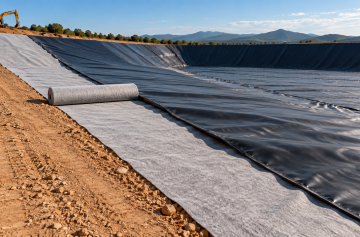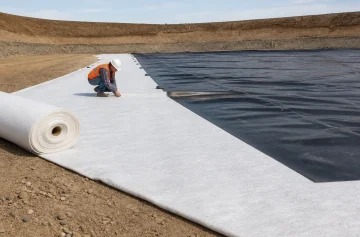
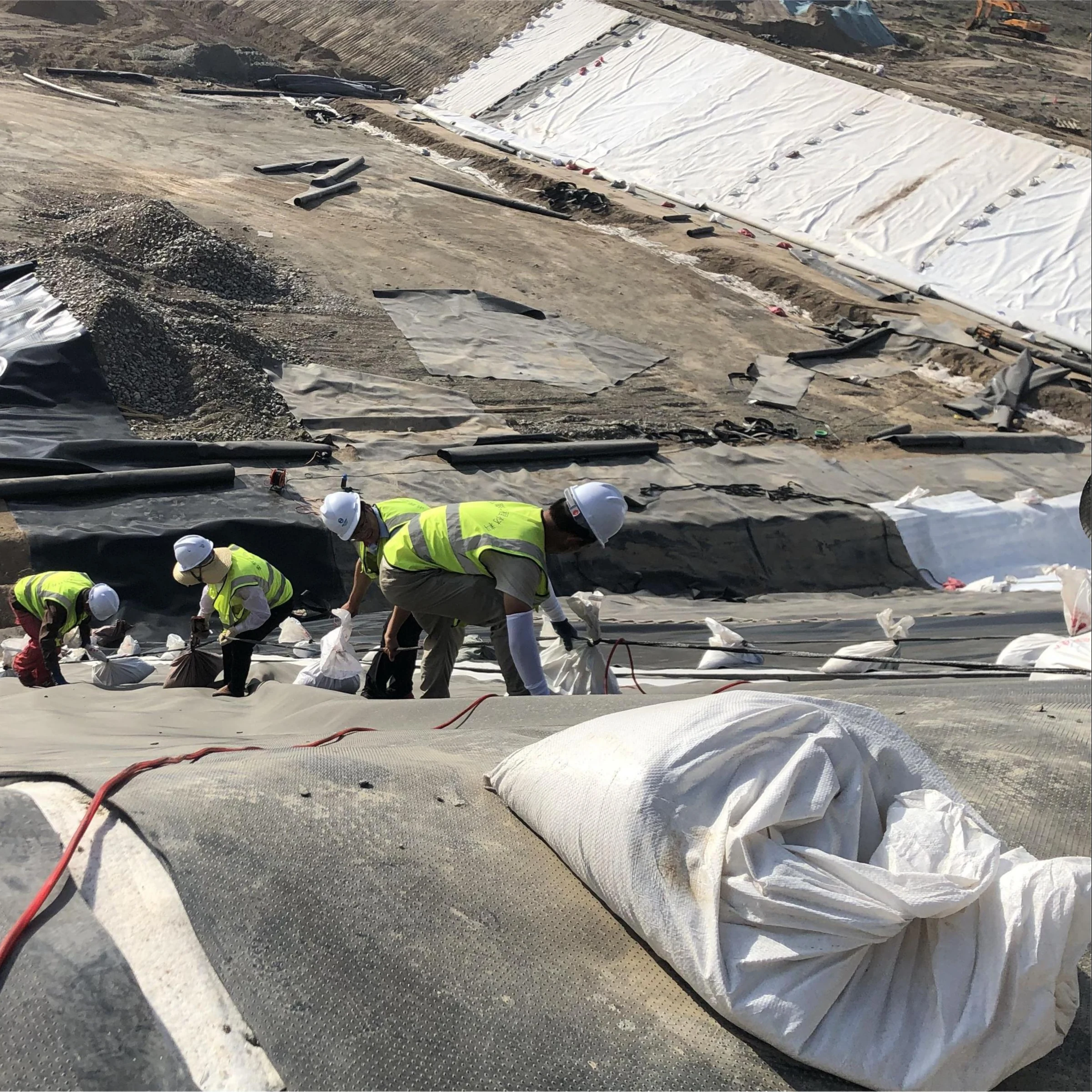
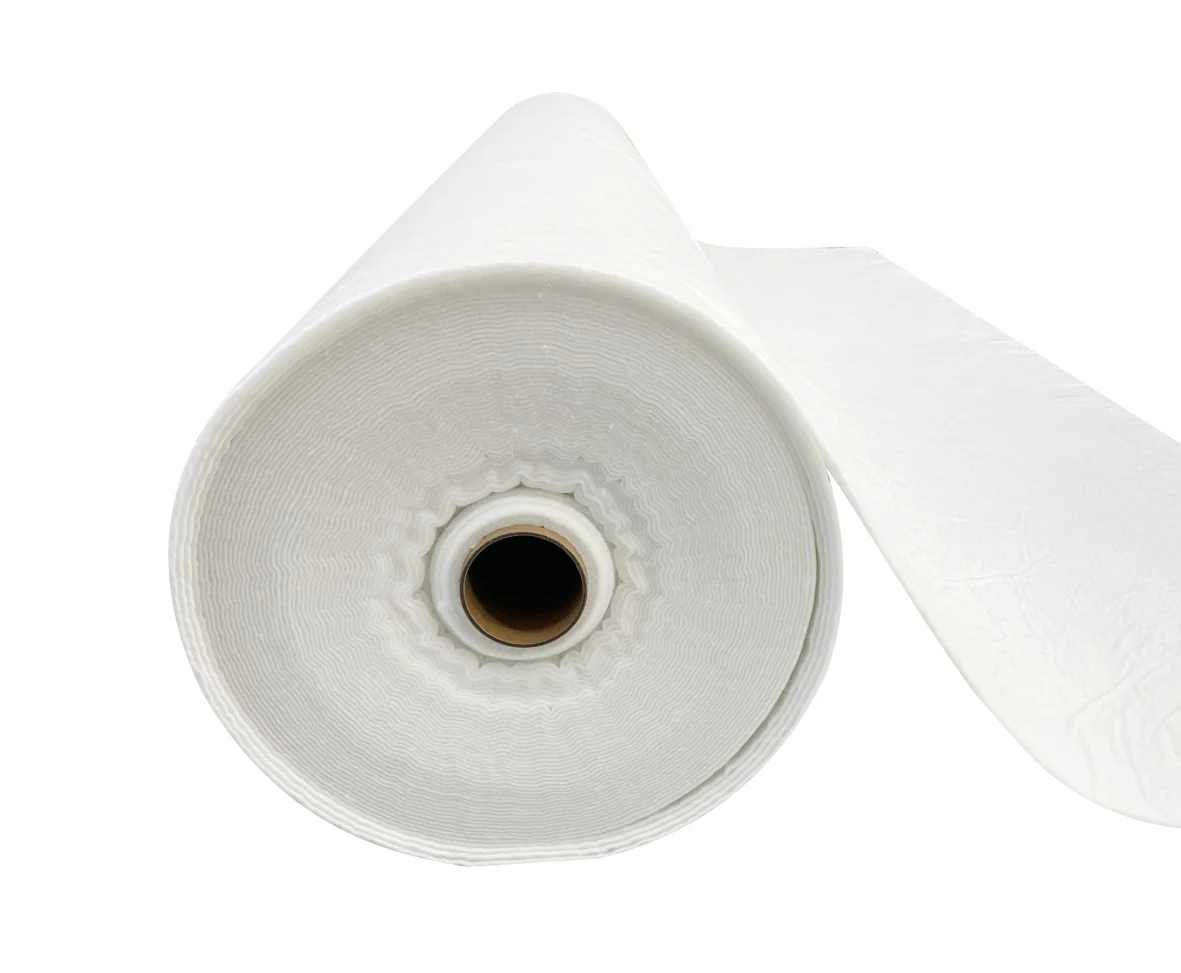

A green roof filter layer takes a PET continuous filament non-woven geotextile, and three tests have to pass together. The pores must hold the fine fraction of the medium, the mass must survive installation loads, and the flow must carry storm water away.
Material comes first. A woven fabric sets its pore size through weave density and runs only 0.3 to 0.5 mm thick, so medium fines pass through. Needle-punched non-wovens reach an O90 of 0.06 to 0.11 mm.
Weight follows medium depth. A medium of 100 to 200 mm takes 200 g/m², one above 300 mm takes 300 g/m² and a pitched roof adds a step.
Retention and drainage are checked together. The O90 is measured against the anti-clogging floor of the medium, and the 50 mm head flow carries a safety factor of five against design rainfall.
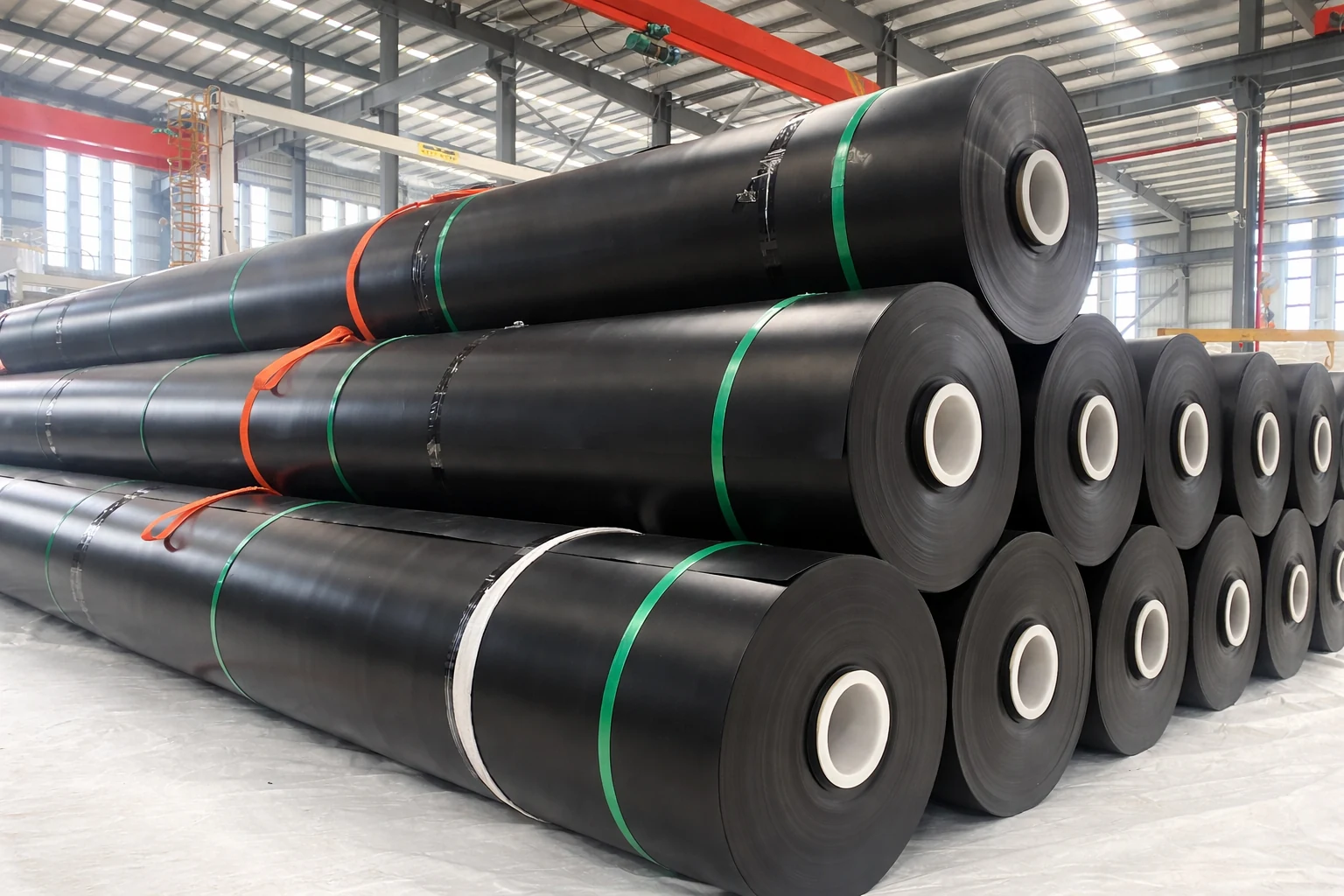
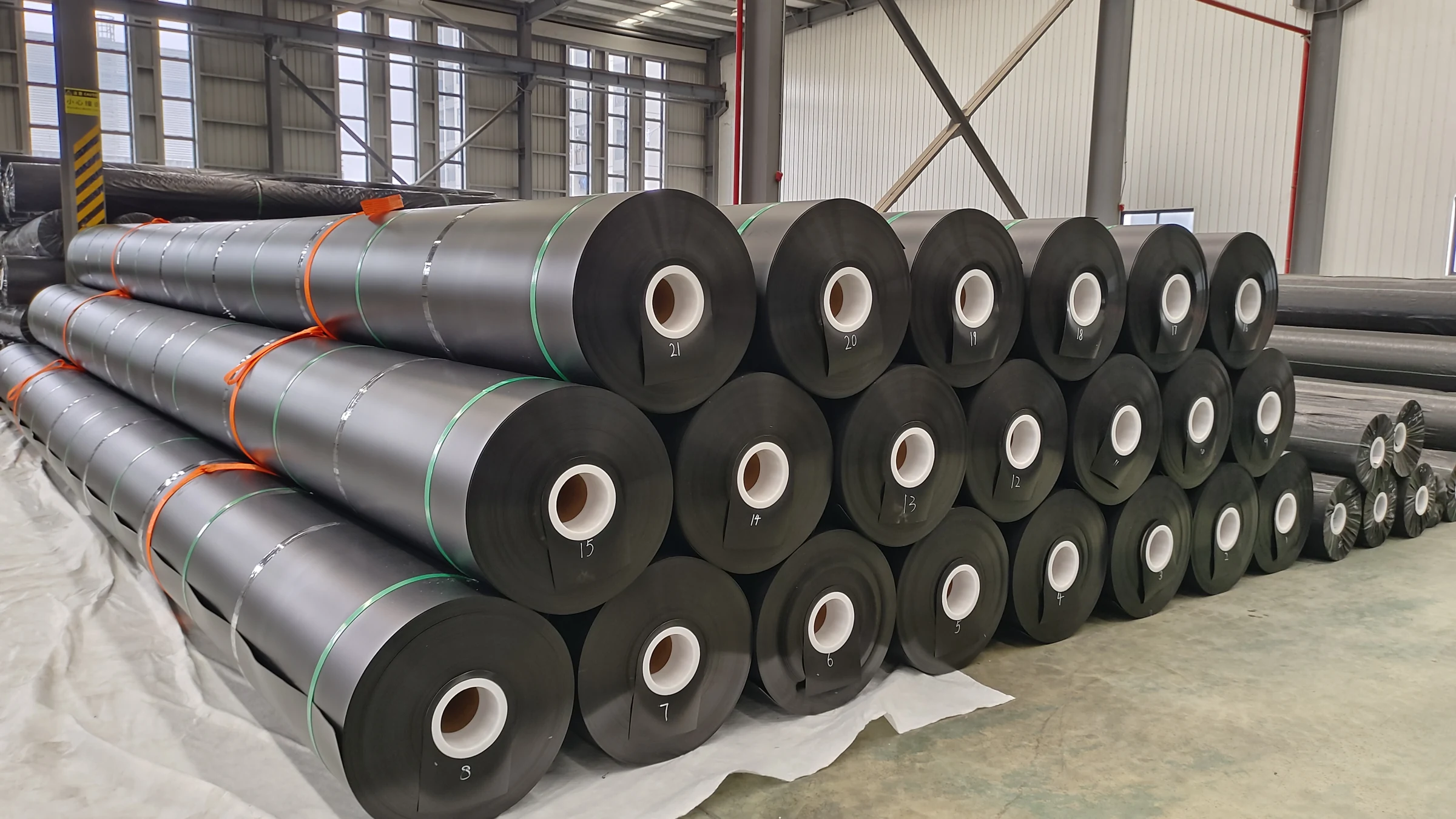
Above the waterproofing a protection fabric of 300 to 600 g/m² carries 3,800 to 7,500 N of puncture. A 6 m wide, 50 m long roll covers 300 m², and a 10,000 m² roof needs 35 rolls after laps.
Position in the roof build-up
The filter layer sits between the growing medium and the drainage board, with protection, root barrier and waterproofing below it. Its own thickness runs from 1.1 to 5.2 mm.
The fabric holds back the fine fraction of the medium and still lets water through. Once fines blind the pores, water collects in a saturated layer, and every 100 mm of head adds 100 kg/m² to the roof load.
Saturated medium tested under ASTM E2399[1] weighs 100 to 150 kg/m² on an extensive roof and up to 400 kg/m² on an intensive one, across 80 to 150 mm and 300 to 600 mm of medium depth. The filter itself adds 0.2 kg/m², or 0.13 to 0.2 percent of the dead load.
Under it, the drainage board stands 20 to 30 mm high and the filter presses down, so the two come to 21.1 to 35.2 mm, under 5 percent of an 800 mm build-up.
Non-woven fabric comes first
A woven fabric is spun from flat tapes 0.3 to 0.5 mm thick, and its pore size follows the weave density, so medium fines pass straight through. The comparison is drawn in woven against non-woven geotextile fabric.
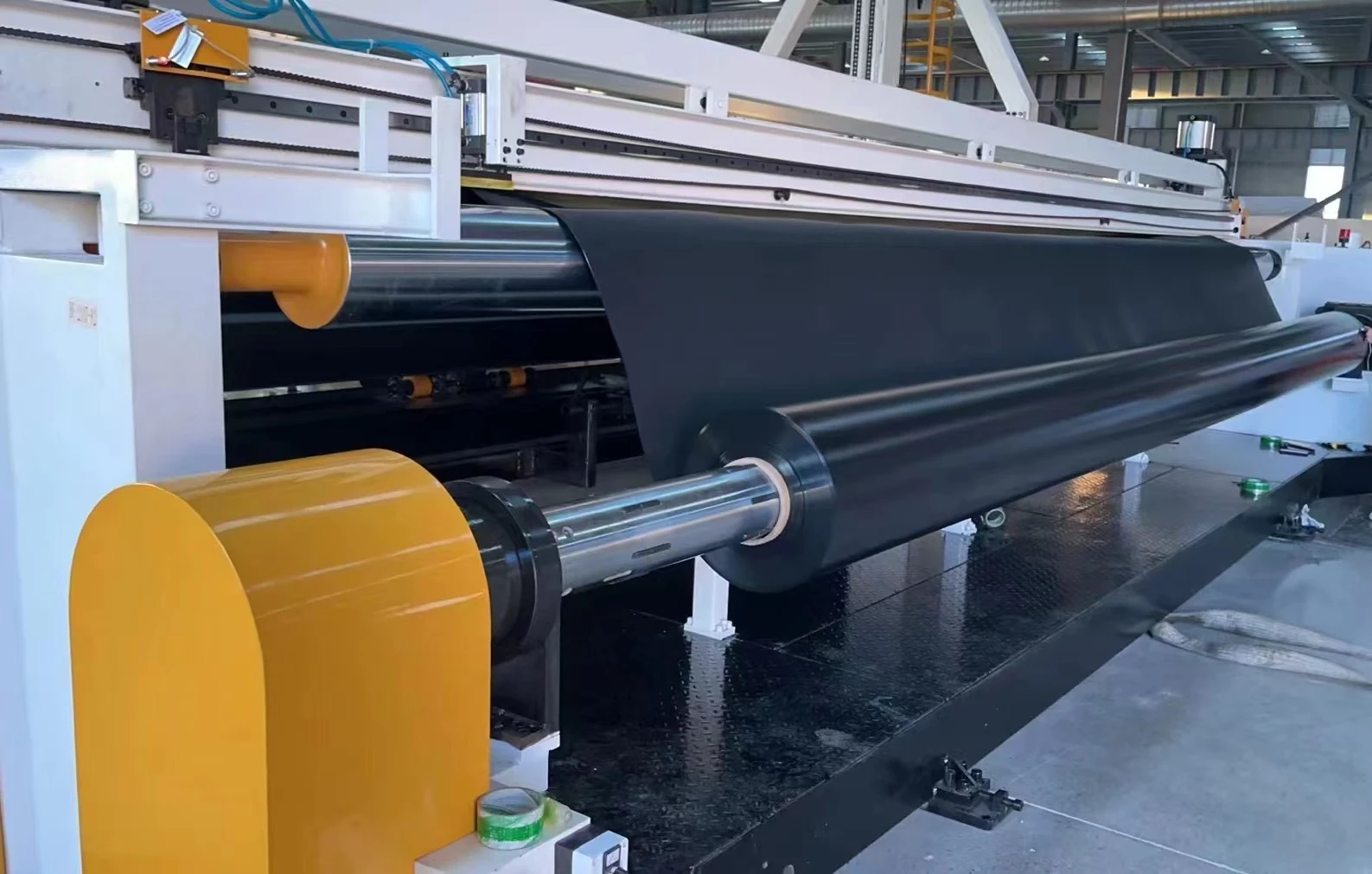
A non-woven is bonded into a random web by needle punching, so the pore range stays narrow. The O90 falls from 0.11 mm to 0.06 mm across the weight range, and machine and cross direction tensile runs from 9.5 to 45 kN/m. ASTM D4439 holds the terms[2].
A continuous PET filament runs unbroken, and the 300 g/m² grade grabs 1,600 N, above a short fibre needle-punched fabric at the same weight, as shown in continuous filament against short fibre non-woven geotextile. GB/T 17639 sets the weight steps used in China[3].
One weight step up costs about 30 percent more per square metre, while the 50 mm head flow falls from 70 to 50 L/s/m² between the 200 and 300 g/m² grades.
Weight by roof type
An extensive sedum roof with 80 to 150 mm of medium takes 200 g/m², or 5.90 oz/yd². A heavier grade adds 0.1 kg/m² of dead load and shifts the O90 by 0.01 mm, and the two layers together add 0.50 kg/m².
Semi-intensive roofs with 200 to 300 mm of medium move to 250 g/m², and intensive ones with 300 to 600 mm take 300 g/m², or 8.85 oz/yd², as set out in geotextile weight selection for planting roofs.
Above a 15 degree pitch the downslope force rises with the angle, so the filter thickens to 300 g/m² and the lap widens to 300 mm. The FLL green roof guideline used across Europe lists the filter layer as a required build-up layer[4].
| Roof type | Medium depth | Filter layer | Equivalent | Protection layer | Lap |
|---|---|---|---|---|---|
| Extensive | 80–150 mm | 200 g/m² | 5.90 oz/yd² | 300 g/m² | 150 mm |
| Semi-intensive | 200–300 mm | 250 g/m² | 7.37 oz/yd² | 400 g/m² | 150 mm |
| Intensive | 300–600 mm | 300 g/m² | 8.85 oz/yd² | 400 g/m² | 150 mm |
| Pitched roof above 15° | 100–200 mm | 300 g/m² | 8.85 oz/yd² | 400 g/m² | 300 mm |
Pore size governs retention
Pores below 0.06 mm blind within a few months. Drainage collapses, water ponds on the roof, and the medium has to come out.
The data sheet quotes O90 in the European convention, while ASTM D4751[5] defines apparent opening size as O95. Both differ on the same roll, so a tender must state which one it quotes.
The 200 g/m² grade comes in at O90 0.10 mm, close to a 140 mesh opening, and the 300 g/m² grade at 0.09 mm, close to 170 mesh.
Blended medium usually has a d50 between 0.5 and 1.5 mm. Working back from O95 no larger than twice d50 puts the pore ceiling at 1.0 to 3.0 mm, so the 0.06 to 0.11 mm range carries nine times the margin needed.
Retention criterion (common engineering practice, applied as guidance): O95 no larger than twice d50 of the protected soil. Permeability criterion: geotextile permeability at least 10 times that of the soil. Clogging criterion: O95 at least three times d15. All three apply together where the medium holds fines.
Drainage and clogging
Flow falls as weight rises. The 125 and 800 g/m² grades differ fivefold at 50 mm head. Green roof filters rarely go above 300 g/m², since 400 g/m² and up is a cushion grade for geomembrane protection.
Clogging comes from three sources, fines carried down by water, biofilm grown by microbes and carbonate scale. Biofilm grows fastest in a damp medium between 15 and 25 °C, while scale follows water hardness and the medium recipe.
An O90 of 0.09 mm against a medium d15 of 0.15 mm fails the anti-clogging floor, since three times d15 is 0.45 mm, five times the pore size. The margin has to come from flow.
| Mass per unit area | Machine and cross tensile | Grab tensile D4632 | CBR puncture D6241 | Tear | Thickness | O90 | Flow at 50 mm head |
|---|---|---|---|---|---|---|---|
| 125 g/m² | 9.5 kN/m | 590 N | 1,500 N | 240 N | 1.1 mm | 0.11 mm | 100 L/s/m² |
| 200 g/m² | 15 kN/m | 880 N | 2,500 N | 350 N | 1.7 mm | 0.10 mm | 70 L/s/m² |
| 300 g/m² | 23 kN/m | 1,600 N | 3,800 N | 540 N | 2.6 mm | 0.09 mm | 50 L/s/m² |
| 400 g/m² | 27 kN/m | 2,050 N | 4,600 N | 610 N | 3.0 mm | 0.09 mm | 40 L/s/m² |
| 600 g/m² | 39 kN/m | 3,000 N | 7,500 N | 920 N | 4.4 mm | 0.08 mm | 30 L/s/m² |
| 800 g/m² | 45 kN/m | 3,800 N | 10,000 N | 1,380 N | 5.2 mm | 0.06 mm | 20 L/s/m² |
Clogging shows up as a drop in permeability. ASTM D5101[6] runs soil against fabric under repeated seepage and measures the residual flow, one test beyond a single O90 value. Data sheet reading is covered in reading a nonwoven geotextile data sheet.
Drainage and clogging criteria (common engineering practice): geotextile transmissivity at least 10 times that of the protected soil; permeability retention above 60 percent, with specimens re-tested under load to ASTM D5493; and a drainage safety factor of at least five between clean water flow and design rainfall.
Each property has its own method. Pore size comes from ASTM D6767[7], in-plane flow from ASTM D4716[8], permeability from ASTM D4491 and ASTM D5493[9][10], and grab tensile and puncture from ASTM D4632 and ASTM D6241[11][12], the second with a 50 mm probe.
Protection layer and root barrier
The protection layer lies on top of the waterproofing and stops mechanical damage during installation and root penetration in service. It starts at 300 g/m², one step above the filter, and takes no part in filtration.
Root resistance is a separate layer, set under the green roof guide ASTM E2777[13]. A geotextile does not provide it, and a tender has to list the two items apart.
On an intensive roof the protection layer takes 400 g/m² and a CBR puncture of 4,600 N. Beyond 400 mm of medium, or where trees are planted, it rises to 600 g/m² and 7,500 N, a gain of 63 percent.
Fabric laps stay at least 300 mm clear of drainage board joints, and no void is allowed between the granular layer and the cloth. Damage seen in geotextile cushion under a geomembrane traces back to laps landing on board joints.
Friction between the protection layer and the waterproofing governs slope stability. ASTM D5321[14] measures the interface by direct shear, and a low friction pair slides as one mass on a steep pitch.
Quantity and rolls
Each roll covers 300 m² at 6 m width and 50 m length. The 150 mm lap takes 2.5 percent of the width and cuts effective cover to 292.5 m², so quotations work from covered area.
A 10,000 m² roof needs 10,250 m² of fabric after laps, or 35 rolls. The 200 g/m² filter weighs 60 kg per roll and comes to 2.10 t, 8.1 percent of a 40HQ container payload.
Its 300 g/m² protection layer weighs 90 kg per roll, reaching 3.15 t. Both layers total 5.25 t, or 20.2 percent of the payload.
A 40HQ container is limited by 26 t of payload and 76 m³ of volume, and the smaller wins. Volume runs out first at 253 rolls, since a 200 g/m² roll measures 0.3 m³.
Both fabrics come to 0.50 kg/m² of supplied area. A 100 mm concrete topping weighs 240 kg/m², so the two geotextiles add 0.21 percent of that figure.
Six items speed up a quotation, product type, weight, roll format, order quantity, destination port and end use. A full brief saves one to three email rounds, trial orders start at 1 to 3 t, and standard grades ship in 7 to 15 days.
| Item | Weight | Roll mass | Rolls | Total mass | Share of 40HQ payload |
|---|---|---|---|---|---|
| Filter layer | 200 g/m² | 60 kg | 35 | 2.10 t | 8.1% |
| Protection layer | 300 g/m² | 90 kg | 35 | 3.15 t | 12.1% |
| Combined | 0.50 kg/m² | 150 kg | 70 | 5.25 t | 20.2% |
For a quote on 6 m wide, 50 m long filter and protection rolls, send the medium depth, roof area and destination port, and the reply carries roll counts, tonnage and a 40HQ loading plan.Request a quotation
Laying and laps
The filter is laid dry over the drainage board with no fixings, so it moves with temperature. Width tolerance runs at 1 percent, or 60 mm on a 6 m roll, and the medium above holds it down. Labels are checked against PET continuous filament roll specifications.
Laps run with the fall, the upstream sheet over the downstream one, at 150 mm on a flat roof and 300 mm on a pitch, with joints staggered by more than 1 m. At upstands the fabric turns 100 mm up the wall and a metal batten holds it.
Side laps work out at 1,750 m across a 10,000 m² roof, based on 6 m roll width. Laying runs at 800 to 1,200 m² per person per day, so a crew of six lays the fabric dry in two days.
Wet weather and the flowering season are best avoided, since PET stiffens below 5 °C and cracks at folded corners.
Foot traffic on saturated medium punches holes in laid fabric. Release testing is covered in factory quality control and release testing, and short weight is checked by the weighing method in 4 oz against 8 oz non-woven geotextile fabric.
Common selection errors
Using 400 g/m² as a filter layer is the commonest mistake. The heavier grade narrows the pores, load lands on the fabric, and drainage fails early. Swapping the filter for a geomembrane traps water, and 100 mm of head adds 100 kg/m² to the roof.
A 150 mm lap on a steep pitch opens by more than 200 mm under its own weight, medium drops through the gap, and settlement shows within three months.
Recycled short fibre fabric scatters its tensile results, and batch ranges usually reach 30 percent or more. Splits on slopes trace back to this class of cheap material.
Treating the filter as a drainage layer is another error. A 2.6 mm cloth offers only 8.7 percent of the flow section of a 30 mm drainage board, so it drains nothing.
Service life and replacement
Buried under growing medium, a PET fabric sees no ultraviolet light and ages mainly through hydrolysis and microbes. Where roof temperature stays below 40 °C the filter lasts as long as the waterproofing. A waterproofing warranty of 10 to 20 years carries over to the filter.
Foot traffic for maintenance is the main external damage source, and a patch of the same grade with a 200 mm lap repairs it. Full replacement means stripping the medium, peeling the old cloth and cleaning the drainage board, usually at 5 to 8 days per 1,000 m² of roof.
Data basis
Figures in the text fall into two groups. Fourteen standards and official sources carry a superscript, and the rest come from converting weight, width, roll format and design rainfall. The 38 conversions are listed below.
Four constants drive the arithmetic. An ounce per square yard is 33.9 g/m², a kN/m is 5.71 lb/in, a mil is 0.0254 mm, and a 40HQ payload is taken as 26 t.
Common trade practice carries no citation here, and covers the 150 mm and 300 mm laps, the 15 degree pitch threshold, the 400 and 600 g/m² protection steps, the 50 m roll length and the 6 m width.
- 1 oz/yd² is 33.9 g/m²
- 200 g/m² is 5.90 oz/yd²
- 250 g/m² is 7.37 oz/yd²
- 300 g/m² is 8.85 oz/yd²
- 400 g/m² is 11.8 oz/yd²
- 600 g/m² is 17.7 oz/yd²
- 1 kN/m is 5.71 lb/in
- 15 kN/m is 85.7 lb/in
- 23 kN/m is 131.3 lb/in
- 1 mil is 0.0254 mm
- 0.10 mm is 3.9 mil
- 6 m by 50 m gives 300 m² per roll
- 150 mm over 6,000 mm gives 2.5 percent
- 300 m² by 0.975 gives 292.5 m²
- 10,000 m² by 1.025 gives 10,250 m²
- 10,250 m² over 300 m² gives 34.2, rounded to 35 rolls
- 200 g/m² by 300 m² gives 60 kg per roll
- 35 rolls by 60 kg gives 2.10 t
- 300 g/m² by 300 m² gives 90 kg per roll
- 35 rolls by 90 kg gives 3.15 t
- 2.10 t plus 3.15 t gives 5.25 t, or 20.2 percent of 26 t
- 5,250 kg over 10,500 m² gives 0.50 kg/m²
- 600 g/m² by 1.025 gives 0.62 kg/m²
- A 100 mm concrete topping is 240 kg/m²
- 0.10 mm is about 140 mesh
- 0.09 mm is about 170 mesh
- 1.1 mm plus 20 mm gives 21.1 mm at the lower end
- 5.2 mm plus 30 mm gives 35.2 mm at the upper end
- 70 L/s/m² down to 50 L/s/m² is a 29 percent fall
- 76 m³ over 0.3 m³ gives 253 rolls before volume runs out
- 0.15 mm times 3 gives 0.45 mm as the anti-clogging floor
- 0.50 kg/m² over 240 kg/m² gives 0.21 percent
- 10,500 m² over 6 m gives 1,750 m of side lap
- 2.6 mm over 30 mm gives 8.7 percent of the flow section
- 10,000 m² over 10,500 m² gives 95.2 percent material use
- 60 kg over 292.5 m² gives 0.205 kg/m² per filter layer
- 1,000 m² needs 3.4 rolls, rounded to 4
- 100 m² of roof takes 20.5 kg of filter layer
Weight and flow figures come from the product data sheet, which covers six grades from 125 to 800 g/m². The filament spunbond range is set out under PET non-woven geotextile and non-woven geotextile for drainage.
Retention depends on how the fibre structure traps fines as well as on pore size, and the 200 and 300 g/m² grades differ by only 0.01 mm in O90. The trade-off is covered under geotextile filter cloth AOS selection.
Long term protection of roots and of surrounding urban fabric belongs with root barrier systems in urban construction, where a tree planting scheme needs 600 g/m² and 0.62 kg/m² at the protection layer.
Sources
- ASTM International. ASTM E2399/E2399M: Standard Test Method for Maximum Media Density for Dead Load Analysis of Vegetative (Green) Roof Systems. www.astm.org
- ASTM International. ASTM D4439: Standard Terminology for Geosynthetics. www.astm.org
- State Administration for Market Regulation of China, Standardization Administration of China. GB/T 17639-2008 Geosynthetics: filament spunbond needle-punched non-woven geotextile, searchable in the National Standards full-text public system [in Chinese]. openstd.samr.gov.cn
- Forschungsgesellschaft Landschaftsentwicklung Landschaftsbau e.V. (FLL). Guidelines for the Planning, Construction and Maintenance of Green Roofing (FLL Green Roof Guidelines). www.fll.de
- ASTM International. ASTM D4751: Standard Test Methods for Determining Apparent Opening Size of a Geotextile. www.astm.org
- ASTM International. ASTM D5101: Standard Test Method for Measuring the Filtration Compatibility of Soil-Geotextile Systems. www.astm.org
- ASTM International. ASTM D6767: Standard Test Method for Pore Size Characteristics of Geotextiles by Capillary Flow Test. www.astm.org
- ASTM International. ASTM D4716/D4716M: Standard Test Method for Determining the (In-plane) Flow Rate per Unit Width and Hydraulic Transmissivity of a Geosynthetic Using a Constant Head. www.astm.org
- ASTM International. ASTM D4491/D4491M: Standard Test Methods for Water Permeability of Geotextiles by Permittivity. www.astm.org
- ASTM International. ASTM D5493: Standard Test Method for Permittivity of Geotextiles Under Load. www.astm.org
- ASTM International. ASTM D4632/D4632M: Standard Test Method for Grab Breaking Load and Elongation of Geotextiles. www.astm.org
- ASTM International. ASTM D6241: Standard Test Method for Measuring Static Puncture Strength of Geotextiles and Geosynthetic-Related Products Using a 50 mm Probe. www.astm.org
- ASTM International. ASTM E2777: Standard Guide for Vegetative (Green) Roof Systems. www.astm.org
- ASTM International. ASTM D5321/D5321M: Standard Test Method for Determining the Shear Strength of Soil-Geosynthetic and Geosynthetic-Geosynthetic Interfaces by Direct Shear. www.astm.org