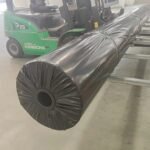
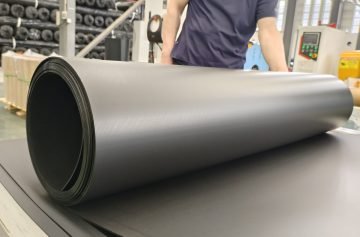
An evaporation pond liner budget starts with purchased liner area × the quoted sheet price per m², then adds delivery, installation, testing, and any protection or leak-detection layers. For the 60 × 40 m pond-floor example below, one layer requires about 5,335 m²: its sheet-only cost is therefore 5,335 × your quoted price per m². A double liner requires about 10,670 m² of sheet, plus the intervening drainage system. These are calculated quantities, not market prices.
A usable monetary estimate needs the liner specification, project location, currency, quotation date, and installation scope. Without those inputs, a universal price range would be misleading. Have qualified personnel determine the design, installation procedures, and acceptance requirements under local rules and the project specification.
What the quoted price includes
Compare sheet-only, delivered, and installed prices separately. Confirm whether each rate applies to purchased rolls, accepted installed area, or another contractual measurement. Water-surface area is not the same as the area of liner you must buy.
| Price basis | What to confirm |
|---|---|
| Sheet only | Polymer, thickness, smooth or textured surface, specification, roll dimensions, quantity, currency, and quotation validity |
| Delivered material | Sheet cost plus agreed freight, unloading, duties, and taxes; state exclusions and delivery terms |
| Installed lining | Material, subgrade preparation, deployment, welding, testing, anchorage, penetrations, supervision, and any specified protection or drainage layers |
Separate initial construction costs from recurring inspection, pumping, monitoring, and cleaning costs. If an installed quotation already includes welding and testing, do not add those items again.
How thickness affects sheet cost
At the same density, doubling thickness doubles nominal sheet mass per square metre. It does not necessarily double the installed project price. GRI-GM13 covers smooth and textured HDPE geomembranes from 0.75 to 3.0 mm, with a minimum-average formulated density of 0.940 g/cm³ [1].
| Nominal thickness | Mass calculation | Approximate smooth-sheet mass |
|---|---|---|
| 0.75 mm | 0.75 × 0.940 | 0.705 kg/m² |
| 1.00 mm | 1.00 × 0.940 | 0.940 kg/m² |
| 1.50 mm | 1.50 × 0.940 | 1.410 kg/m² |
| 2.00 mm | 2.00 × 0.940 | 1.880 kg/m² |
| 2.50 mm | 2.50 × 0.940 | 2.350 kg/m² |
The conversion is thickness in millimetres × density in g/cm³ = mass in kg/m². These calculations use 0.940 as an assumption, not a measured roll density. Obtain actual roll mass and dimensions for purchasing and freight; texture and manufacturing tolerances can change the result.
If the supplier quotes per kilogram, a nominal 1.5 mm smooth sheet at the assumed density costs 1.41 × the quoted price per kilogram per m². Compare that converted rate with a per-m² pond-liner quotation on the same material and delivery basis.
Thickness also changes the specified mechanical properties. The following are GRI-GM13 minimum-average values for smooth HDPE, not measurements from a Jinseed production batch [1].
| Thickness | Yield strength, ASTM D6693 | Break strength, ASTM D6693 | Tear resistance, ASTM D1004 | Puncture resistance, ASTM D4833 |
|---|---|---|---|---|
| 0.75 mm | 11 kN/m | 20 kN/m | 93 N | 240 N |
| 1.00 mm | 15 kN/m | 27 kN/m | 125 N | 320 N |
| 1.50 mm | 22 kN/m | 40 kN/m | 187 N | 480 N |
| 2.00 mm | 29 kN/m | 53 kN/m | 249 N | 640 N |
Do not apply the smooth-sheet table to textured sheet. For example, the 1.5 mm textured puncture minimum is 400 N rather than 480 N, and its break-elongation minimum is 100% rather than 700%; both have a 12% yield-elongation minimum under the stated test method [1].
Choosing material and surface
- Smooth HDPE. Jinseed supplies HDPE liner for containment applications. Approve the quoted formulation against the expected liquid and temperature, including the concentrated conditions discussed for brine ponds.
- Textured HDPE. Single- or double-sided textured liner changes the interfaces in the lining system. Choosing smooth versus textured HDPE requires project-specific interface-shear and slope-stability assessment; a rough surface alone does not establish a safe slope.
- LLDPE. Consider LLDPE liner where the design needs greater flexibility, including settlement areas or irregular details. Specify the applicable LLDPE requirements separately rather than treating GM13 as an LLDPE specification.
- EPDM and PVC. These are alternatives for comparison, including some ornamental-pond applications. They are not presented here as Jinseed products or as automatically suitable for industrial wastewater.
Why evaporation service changes the budget
Concentrated liquid chemistry
Assess the liquid through its operating cycle, not just the incoming water. Dissolved nonvolatile constituents can become more concentrated as water evaporates; volatile compounds and precipitating salts do not all behave the same way. For hazardous-waste surface impoundments within its scope, 40 CFR §264.221 requires appropriate liner chemical properties, strength, thickness, and foundation support for the waste, climate, installation, and operating stresses [2].
For mining and environmental containment, ask for compatibility evidence relevant to the actual formulation, liquid composition, and temperature. A generic polymer description does not establish compatibility for a specific pond.
Heat and exposed-sheet movement
Where the liner is exposed, include temperature variation, wrinkles, wind restraint, and deployment sequencing in the installation plan. The UV and temperature exposure conditions belong in the specification. Increasing thickness alone does not resolve thermal movement.
Solids removal and access
Price the planned cleaning method before selecting protection. In sludge-handling ponds, equipment contact, access routes, and abrasion may require a designed protection arrangement. Do not assume that a thicker sheet or a geotextile cushion makes direct machine scraping safe. Include these operating inputs in the evaporation-pond system design.
Permit and leak-detection requirements
For the hazardous-waste surface impoundments covered by §264.221(c), the prescribed design requires two or more liners and an intervening leachate collection and removal system serving as leak detection, subject to the regulation’s alternatives and exemptions. The composite bottom liner includes at least 3 feet (91 cm) of compacted soil with hydraulic conductivity no greater than 1 × 10⁻⁷ cm/s. These are not universal requirements for every evaporation pond [2].
Single versus double lining systems
A second geomembrane increases sheet quantity substantially, but doubling sheet quantity does not mean doubling every construction cost. Price the complete section, including sumps, drainage, and monitoring.
| System component | Budget effect |
|---|---|
| Single geomembrane | One sheet layer, seams, testing, anchorage, and any specified underlay; no second geomembrane barrier |
| Geomembrane over compacted low-permeability soil | Adds soil supply or processing, placement, compaction, and hydraulic-conductivity verification |
| Double geomembrane with drainage and leak detection | Approximately twice the sheet area for similar layer extents, plus a drainage layer, sumps, pumps, and a monitoring arrangement |
| Protection geotextile | Material and placement costs for a specified PET continuous-filament nonwoven geotextile; select geomembrane protection for the actual loading and subgrade puncture conditions |
For the leak-detection system prescribed by §264.221(c)(2), the minimum bottom slope is 1%. Granular drainage must have hydraulic conductivity of at least 1 × 10⁻¹ cm/s and thickness of at least 12 inches (30.5 cm); the synthetic or geonet alternative has minimum transmissivity of 3 × 10⁻⁴ m²/s. Chemical resistance, clogging resistance, loading, and sump measurement requirements also matter [2].
These containment components also appear in landfill lining systems, but an evaporation pond must be designed for its own permit and liquid. EPA’s land-disposal training material provides additional regulatory background [3].
Evidence to request with the quotation
Ask the geomembrane supplier for the quoted product specification and relevant quality records. For HDPE specified to GM13, distinguish laboratory acceptance thresholds from actual batch results and service-life predictions.
| Property | Method and requirement to confirm |
|---|---|
| Thickness and density | ASTM D5199 for smooth thickness or D5994 for textured thickness; D1505 or D792 for formulated density; use the applicable roll-average and individual-value rules |
| Mechanical properties | D6693 tensile, D1004 tear, and D4833 puncture; match the surface and nominal thickness |
| Carbon black | D4218 content: 2.0–3.0%; D5596 dispersion: 10 views, nine in Categories 1 or 2 and one in Category 3 |
| Initial OIT | D8117 standard OIT: minimum average 100 minutes; or D5885 high-pressure OIT: minimum average 400 minutes |
| Oven ageing | D5721, 90 days at 85°C: minimum-average retained standard OIT 55%, or high-pressure OIT 80% |
| UV resistance | D7238: at least 50% retained high-pressure OIT after 1,600 hours; cycle of 20 hours UV at 75°C and 4 hours condensation at 60°C |
| Stress-crack resistance | D5397 Appendix: 500-hour minimum; for textured material, test smooth edges or smooth sheet of the same formulation |
| Textured asperity height | D7466: 0.40 mm minimum average under GM13; this is not a substitute for interface-shear assessment |
The HDPE thresholds above come from GRI-GM13 Revision 19. They do not establish a number of years of field life or prove chemical compatibility with a particular waste [1].
Installation costs beyond the sheet
- Earthwork and subgrade. Include excavation, grading, soft-ground treatment, removal of damaging protrusions, and groundwater management where required. FAO pond-construction guidance illustrates how site topography, soil investigation, and moved-earth volume affect construction; its earthen fish-pond guidance is not a substitute for an engineered industrial liner design [4].
- Anchorage and details. Price pipe boots, sumps, concrete interfaces, anchor trenches, and cell dividers from the drawings rather than from floor area alone.
- Welding and acceptance. State trial-seam requirements, nondestructive testing, destructive sampling, repairs, retesting, and independent construction quality assurance. ASTM D6392 concerns testing thermofusion seams; it is not a complete installation or acceptance plan. GRI-GM29 describes field-integrity evaluation using destructive and/or nondestructive approaches [5]. EPA’s seam-fabrication guidance addresses inspection and seam evaluation in more detail [6].
- Mobilisation and access. State crew travel, equipment access, unloading arrangements, weather allowances, and the construction programme. Keep these separate from the sheet rate unless expressly included.
Worked quantity and cost calculation
This illustrative calculation is not a completed Jinseed project or a supplier quotation. Assume a rectangular 60 × 40 m floor, a 3 m vertical lining height, and uniform 1V:3H side slopes. The lining height is an arithmetic assumption, not a recommended operating depth; a real design must include the required freeboard and crest details.
Each bank extends 9 m horizontally and has a sloping length of √(3² + 9²) = 9.487 m. The upper rectangle is 78 × 58 m. Using four trapezoidal sides:
Lined area = 60 × 40 + 2 × [(60 + 78) ÷ 2 × 9.487] + 2 × [(40 + 58) ÷ 2 × 9.487] ≈ 4,638.9 m².
Apply an illustrative 15% allowance for overlaps, anchorage, details, and cutting waste to obtain about 5,335 m² for one layer. The allowance is not a standard requirement: replace it with a panel layout and measured details for purchasing. A liner-area take-off must include those details explicitly.
| Illustrative allowance on 4,638.9 m² | Single-layer purchased area |
|---|---|
| 10% | About 5,103 m² |
| 15% | About 5,335 m² |
| 20% | About 5,567 m² |
At 1.5 mm and the assumed density, the 15% single-layer quantity weighs approximately 7,522 kg, or 7.52 tonnes of sheet, excluding cores and packaging. Two layers with the same assumed extents require about 10,670 m² in total. Actual upper and lower layer quantities can differ.
If P is the quoted sheet price per m², the single-layer sheet cost is approximately 5,335P. If K is the price per kilogram, the same nominal calculation gives approximately 7,522K. Use one pricing basis, not both, and obtain actual roll data before ordering. A sheet-cost calculation still needs separate delivery and installation amounts to become a project budget.
A practical quotation-comparison scenario
Suppose two bids describe the example pond differently: one uses the 2,400 m² floor area, while the other includes the slopes and the 15% allowance, totalling 5,335 m². At an identical sheet rate, the second material total is about 2.22 times the first. That difference comes from quantity scope, not necessarily from a more expensive supplier. This is a constructed comparison based on the calculation above, not a claim about actual customer enquiries.
Before choosing between bids, reconcile the area take-off, material specification, and exclusions. Then check that the welding and seam-testing scope is equivalent. If electrical leak location is specified, confirm the method, site preparation, coverage, and repair responsibilities rather than assuming it is included in routine seam testing.
What to send for a project quotation
- Drawings showing floor dimensions, lining height, operating depth, freeboard, side slopes, cells, and crest details.
- Liquid composition, expected concentrated conditions, temperature range, solids, and the proposed cleaning method.
- Required polymer, nominal thickness, surface, and material acceptance specification.
- Single or double lining, protection geotextile, drainage, sumps, and monitoring requirements.
- Purchased and installed areas, with the take-off and allowance method clearly stated.
- Delivery location, unloading and tax terms, installation responsibilities, and the testing and acceptance plan.
- Quotation currency, date, validity, programme, and itemised exclusions.
For hydraulic containment and industrial evaporation ponds, these inputs let suppliers quote the same scope instead of different interpretations of the pond.
Send Jinseed your pond drawings, liquid conditions, and lining specification for a project-specific HDPE or LLDPE quotation.
References
- Geosynthetic Institute. GRI-GM13, Revision 19, 11 June 2025: Test Methods, Test Properties and Testing Frequency for HDPE Smooth and Textured Geomembranes. Tables 1(b) and 2(b), including test conditions and footnotes. Accessed 9 November 2026.
- Electronic Code of Federal Regulations. 40 CFR §264.221: Design and operating requirements. Paragraphs (a), (c), and the alternatives and exemptions in (d)–(f). Accessed 9 November 2026.
- U.S. Environmental Protection Agency. Introduction to Land Disposal Units. Regulatory training background on surface impoundments and lining systems. Accessed 9 November 2026.
- Food and Agriculture Organization of the United Nations. Fish culture in undrainable ponds: site selection and pond construction. Used for site and earthwork considerations, not industrial containment specifications. Verification record dated 4 November 2026.
- Geosynthetic Institute. GRI-GM29: Field Integrity Evaluation of Geomembrane Seams (and Sheet) Using Destructive and/or Nondestructive Testing. Scope and referenced seam-testing methods. Accessed 9 November 2026.
- U.S. Environmental Protection Agency. Inspection Techniques for the Fabrication of Geomembrane Field Seams, EPA/530/SW-91/051, May 1991. Historical technical guidance; use with the current project specification. Accessed 9 November 2026.